Pattern Card — Canonical Layer Stack
The 7-layer stack is fixed and semantically ordered. Reordering is a doctrine violation.
Visual
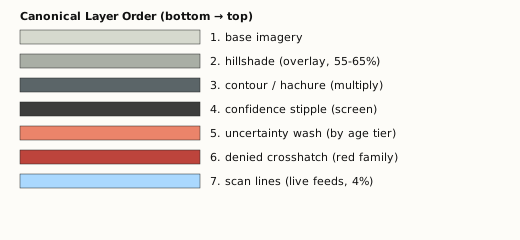
Order (bottom → top)
| # | Layer | Blend | Opacity | When suppressed |
|---|---|---|---|---|
| 1 | Base imagery / neutral substrate | normal |
100% | Never (foundational) |
| 2 | DEM hillshade | overlay |
55–65% | Never on a degraded edge device with terrain context required |
| 3 | Contour or hachure slope overlay | multiply |
100% | Performance suppression (after stipple) |
| 4 | Confidence stipple | screen |
variable by provenance | First performance suppression on field tablet |
| 5 | Uncertainty wash | normal |
variable by age tier | Last performance suppression — semantic loss is significant |
| 6 | Denied-zone crosshatch | normal |
100% | Never (always required when geometry present) |
| 7 | Scan-line overlay | normal |
4% | Whenever the surface is not a live ingest |
Suppression order (field tablet, max 3 simultaneous textures)
- Semantic suppressions (apply unconditionally before budget math)
- Suppress scan_line_overlay when feed is not live (
non_live_cached_feed)
- Suppress scan_line_overlay when feed is not live (
- Performance suppressions (apply in priority order until under budget)
- Drop
confidence_stipple - Drop
contour_hachure - Drop
uncertainty_wash(last resort — semantic loss is significant)
- Drop
- Emit
REDUCED_SEMANTIC_FIDELITYwarning whenever any performance suppression fires.
Why this order
The stack reads bottom-to-top in trust hierarchy: terrain truth at the bottom, operational state in the middle, denial geometry above all terrain interpretation, live signal indication on top. Inverting any pair changes what the operator sees first — and therefore changes what they trust first.
Tokens reference
Layer compositing parameters live alongside the doctrine in SKILL.md. Per-layer fills/strokes live in tokens.json.