SIGINT Terrain Rendering Engine — v2.1
A deterministic compiler that transforms terrain elevation, telemetry freshness, provenance, and denied-space geometry into audit-friendly tactical 2D/3D outputs. The system acts like a compiler, not a stylist.
📦 Repository: augustave/SIGINT-TWO · 📖 Glossary · 📜 README
What This Is
This repository is a specification bundle — not a runtime. It is the complete, machine-checkable design contract for a SIGINT terrain rendering engine that downstream coding agents (or human implementors) can build against without inventing layer rules, field names, or fallback behavior.
The bundle treats rendering as evidence handling. Every visible mark on the screen must answer a tactical question. Texture, tone, contour, and wash are operational encodings — never cosmetic effects.
Why this design exists
Most terrain rendering systems collapse operational meaning into visual taste. Stipple becomes “decoration.” Crosshatch becomes “pattern fill.” Color becomes a palette choice. The result: feed freshness, provenance, and denial semantics drift between screens and device classes, and operators stop trusting what they see.
This bundle locks down those semantics. The renderer is required to fail loudly when trust state is uncertain, rather than render something pretty and ambiguous.
Core Doctrine
| Invariant | Meaning |
|---|---|
| Texture Is Meaning | Grain = provenance/confidence. Hatching = slope severity. Crosshatch = denied/contested area. Wash = data age. None of these are decorative. |
| Compositing Is Law | The 7-layer canonical order is fixed and semantically meaningful. Reordering is a doctrine violation. |
| Terrain Must Be Honest | All elevation rendering must declare datum, source class, and z-exaggeration. No silent assumptions. |
| Degradation Must Be Visible | Performance fallback is allowed; silent semantic loss is not. Every suppressed layer must carry a reason. |
Design System Overview
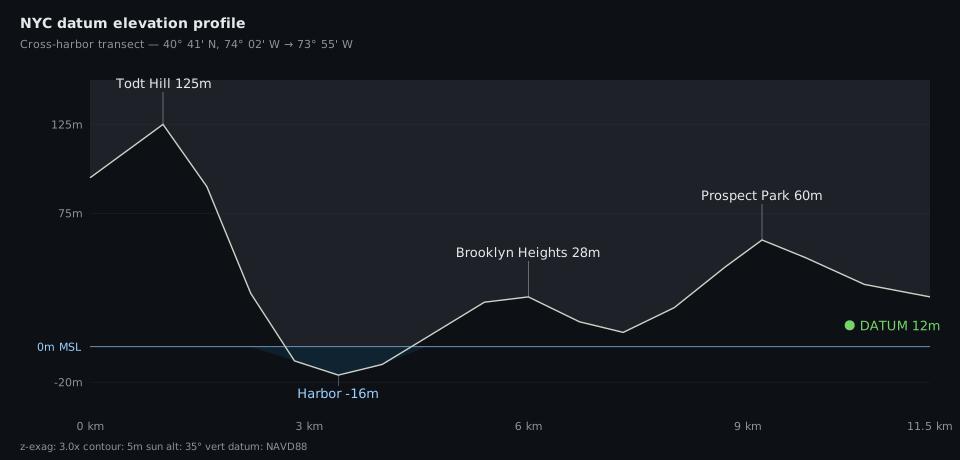
The full doctrine surface — terrain textures, confidence/uncertainty washes, slope severity with mobility classes, hypsometric tinting, and the canonical NYC harbor elevation profile — on the dark tactical substrate.

The 7-Layer Canonical Stack
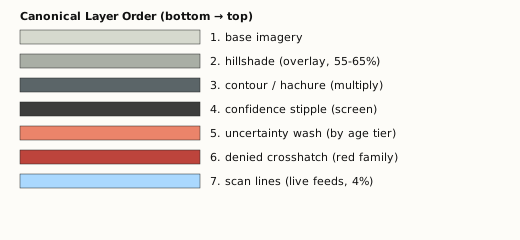
Layer order is fixed and semantically ordered. Reordering is a doctrine violation. → Layer Stack pattern card
Multi-Agent Architecture
The renderer is decomposed into 10 cooperating agents (full topology in SWARM.md):
┌─────────────────────────┐
│   RenderOrchestrator    │  ← entry point; owns the run, merges outputs
└────────────┬────────────┘
             │
   ┌─────────┼──────────────────────────────┐
   ▼         ▼                              ▼
TerrainProfile  DatumNormalization   TerrainInterpretation
   Agent          Agent                 Agent
                                          │
            ┌─────────────────────────────┼─────────────────────────┐
            ▼ (parallelizable)            ▼                         ▼
       TelemetryState              ThreatOverlay              LOSFresnel
          Agent                       Agent                     Agent
            └─────────────────────────────┼─────────────────────────┘
                                          ▼
                              LayerCompilation
                                  Agent
                                          │
                                          ▼
                              Verification → Packaging
                                  Agent      Agent
Steps 5, 6, and 7 (Telemetry, Threat, LOS/Fresnel) have no inter-dependencies and may run concurrently.
Error propagation: Blocking errors halt downstream dependents immediately. Non-blocking warnings accumulate into the manifest. The PackagingAgent must include all warnings even in blocked outputs — a blocked package is still a valid, reproducible artifact explaining the block.
Pattern Cards
Each card pairs a visual primitive with the doctrine that governs it.
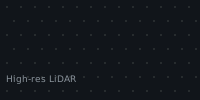
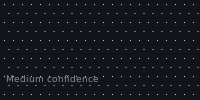
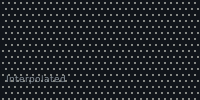
Confidence Stipple
Grain density encodes provenance. Higher density = lower trust.
| High-res LiDAR | Medium | Interpolated | Synthetic |
|---|---|---|---|
 |
 |
 |
 |
Uncertainty Wash
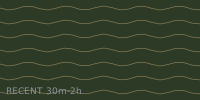
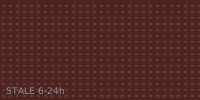
Wash saturation encodes feed age. CURRENT shows nothing. A feed with no timestamp never becomes CURRENT or RECENT — it is forced to STALE plus a hard warning, or, if safety-relevant, the entire output is blocked.
| CURRENT | RECENT | AGING | STALE | HISTORICAL |
|---|---|---|---|---|
 |
 |
 |
 |
 |
Slope Hachure
Hachure spacing encodes slope severity. Each band carries a doctrine mobility classification.

| 3–10° (wheeled) | 10–20° (tracked) | 20–30° (dismount) | 30–45° (technical) | 45–90° (cliff) |
|---|---|---|---|---|
 |
 |
 |
 |
 |
Denied / Contested Zones
High-contrast crosshatch in the red family. Never feathered, never decorative.

Live Scan Lines (4% opacity)
Applied only to live ingest surfaces. Never to archived stills or analysis exports.

Tactical Hypsometric Tinting
The only permitted continuous hypsometric ramp — bathymetric through alpine. Rainbow ramps are prohibited. The first five above-zero bands are the subset used by nyc_littoral_low_relief.

Hillshade Grain & Contour Hachure
Hillshade is the substrate; contours are the iso-elevation overlay. Both shown here as reference swatches; production rendering is computed from the DEM.
| Hillshade grain | Contour hachure |
|---|---|
 |
 |
NYC Harbor Elevation Profile
Doctrine reference for the elevation_profile output mode under the nyc_littoral_low_relief terrain profile. Cross-harbor transect with NAVD88 vertical datum, 5 m contour interval, z-exaggeration 3.0×, and bathymetric merge.
Terrain Profiles
| Profile | Use case | Notable parameters |
|---|---|---|
standard_regional |
General regional viewport | z-exaggeration by zoom table, 10 m contour interval, 45° hillshade altitude |
nyc_littoral_low_relief |
NYC harbor / low-relief coastal | z-exaggeration 3.0, 5 m contours, 35° altitude, mandatory bathymetry merge if water crossed |
alpine_high_delta_z |
High-relief mountain terrain | z-exaggeration clamped 1.0–1.5, contours over hillshade microtexture |
urban_canyon_lidar |
Dense urban LiDAR contexts | Bare-earth DEM preferred; LOS requires building-contamination warning if DSM used |
Device Classes & Degradation
| Device | Texture budget | Degradation behavior |
|---|---|---|
desktop_analyst |
Full 7-layer stack | 2D + profile + optional 3D |
field_tablet |
Max 3 simultaneous textures | Semantic suppressions first (scan_line on non-live), then performance suppressions in priority order: stipple → contour → wash. Always emit REDUCED_SEMANTIC_FIDELITY. |
degraded_edge_device |
Hillshade + 1 operational overlay | Suppress 3D. Emit degraded-state badge. |
Output Contract
Every successful run produces a reproducible package:
/layers/*                      # Compiled layer assets
/patterns/*                    # SVG / shader patterns
/shaders/*                     # GLSL or equivalent
/profiles/*                    # Selected terrain profile parameters
/render_state_manifest.json    # Authoritative state record
/verification_report.md        # Human-readable pass/fail report
The render_state_manifest.json is validated end-to-end against common-schema.yaml.
Acceptance Gates
A render is valid only if all of the following are true:
- Layer order matches the canonical 7-layer stack
- No illegal palette is used (no rainbow hypsometric, no decorative denied-zone patterns)
- Timestamp-less feeds are not displayed as
CURRENTorRECENT - Water-crossing profiles use bathymetric fill or explicitly mark
bathymetry_unavailable - 3D mode respects terrain profile and device budget
- Output manifest explains every suppressed or degraded layer with a
reason
Failure Modes (Hard Stops)
| Condition | Required behavior |
|---|---|
| Sensor timestamps absent in safety-relevant view | [BLOCKED: feed freshness undefined. CURRENT/RECENT prohibited.] |
| LiDAR rooftop contamination in LOS mode | Switch to bare-earth DEM or emit LOS_UNSAFE_DSM_CONTAMINATION |
| Bathymetry missing for harbor-crossing transect | Block bathymetric fill, emit BATHYMETRY_REQUIRED_FOR_WATER_CROSSING |
| Fresnel request without declared frequency class | Reject request at validation |
| Device cannot sustain required blend modes | Reduced-fidelity package with REDUCED_SEMANTIC_FIDELITY warning |
Conformance
Two acceptance fixtures any compliant implementation must reproduce exactly:
nyc_harbor_low_relief— field-tablet LOS + Fresnel across a harbor crossing, bathymetric merge required, aging telemetry. Expected status:warn.missing_timestamp_los_blocked— safety-relevant LOS request against a feed with notimestamp_utc. Expected status:blocked.
Validate locally:
pip install pyyaml jsonschema
python3 scripts/validate.py
The same script runs in CI on every push.
Reference
- SKILL.md — full doctrine
- SWARM.md — multi-agent topology
- PRD.yaml — product requirements
- common-schema.yaml — JSON Schema contracts
- Glossary — domain acronyms (SIGINT, NAVD88, Fresnel, DSM, EOIR, …)
Generated SVGs come from scripts/build_patterns.py reading sigint_terrain_bundle/tokens.json. Single source of truth for the palette.